
How to Scan a Food Barcode to Count Calories
Updated August 28, 2026 3 min read
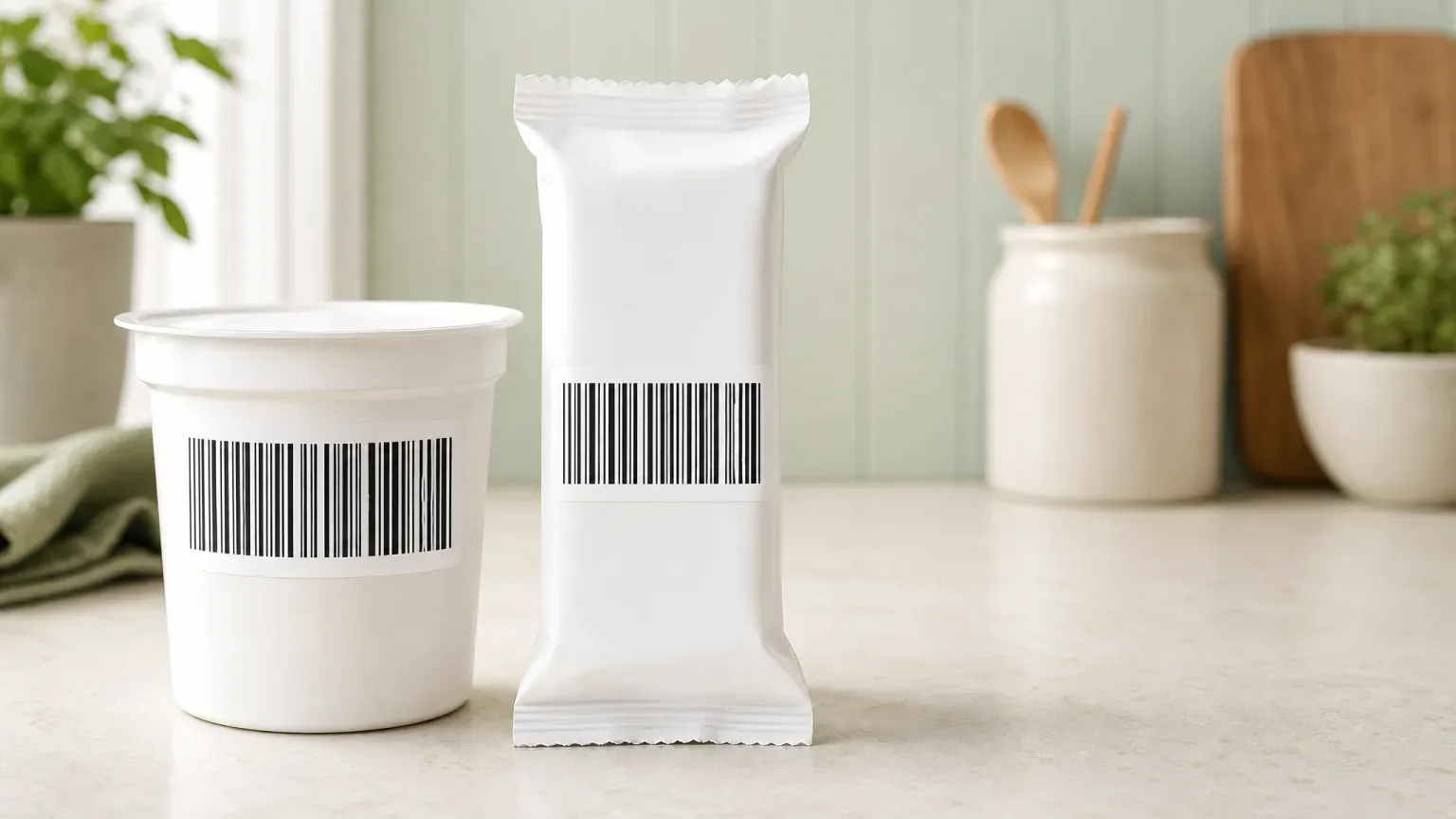
Point your tracker’s camera at the barcode on the package and the app looks that product up in a food database, then fills in calories, protein, carbs and fat from the manufacturer’s own label. It takes about two seconds and it is the most accurate way to log anything that comes in packaging, because nothing is being estimated. The number was printed by the company that made the food.
What actually happens when you scan
The barcode is an identifier, not nutrition data. The stripes encode a product number, usually a 13-digit EAN in Europe or a 12-digit UPC in North America.
Your app reads that number and queries a food database that maps product codes to nutrition panels. Open Food Facts, a collaborative database with several million products, is the most widely used source. The app receives the panel, converts it to your serving, and writes the entry to your diary.
Two consequences follow from this design. Coverage depends on the database rather than the app, and accuracy depends on whoever entered the panel. For major brands both are reliable.
The serving-size trap
This is the mistake that survives even perfect scanning, and it is worth belaboring because it is so common.
Nutrition labels report per serving. The package frequently contains more than one. A bag of chips showing 150 calories is 150 calories per serving at three servings a bag, which is 450 calories if you finish it. A 500 ml bottle of soda can be listed as two servings. A jar of peanut butter is often sixteen.
When a scan returns a product, look at the quantity field before you save. Decide how much of the package you ate and set the number of servings to match. Everything else in the entry is exact, so this is the only step where you can be wrong.
When the scan comes back empty
Barcode databases are strongest where their contributors live, which means US and European products dominate. If you shop in Mexico, Russia or anywhere outside that concentration, expect gaps. Store-brand items and recently launched products are the other common misses.
Three fallbacks, in order:
- Search the product by name. The item is often in the database, but that specific package or regional variant is not.
- Enter the label once. Type the values from the panel. Most apps save the product against that barcode, so the next scan finds it.
- Photograph the food instead. For a packaged meal you have already opened, estimating from the plate is faster than typing.
Where barcodes stop working
Barcode scanning solves packaged food completely and unpackaged food not at all. There is no barcode on a plate of pasta you cooked, a restaurant main, a piece of fruit, or anything served to you by another person. That is most of what people eat.
So the practical setup is to use both. Caloryx puts barcode scanning and photo recognition behind the same camera: scan the yogurt pot and the protein bar off their labels, photograph the dinner you cooked, and search by name for the apple. All three land in the same daily total with the same macro breakdown.
Accuracy, ranked
For a realistic sense of how the methods compare:
- Barcode: around 5 percent off, limited by label tolerances and how honestly the manufacturer rounded.
- Weighed ingredients from a database: similar, if you log raw and weigh in grams.
- Photo recognition: roughly 10 to 20 percent on common meals, better when the food is clearly visible and separated.
- Recalling it from memory that evening: unreliable in a way that is consistently biased downward.
The last line is the real comparison. Any of the first three beats reconstructing your day at bedtime, which is what happens when logging takes long enough to postpone.
A workable routine
Scan the packaged items as you open them, since the barcode is in your hand anyway and it takes two seconds. Photograph plated meals. Save the products and recipes you repeat, so your regular breakfast becomes one tap rather than a fresh lookup every morning. Within a couple of weeks most days consist of entries you have logged before, and the work drops to almost nothing.
