
How to Set Macro Goals for Weight Loss
Updated August 28, 2026 4 min read
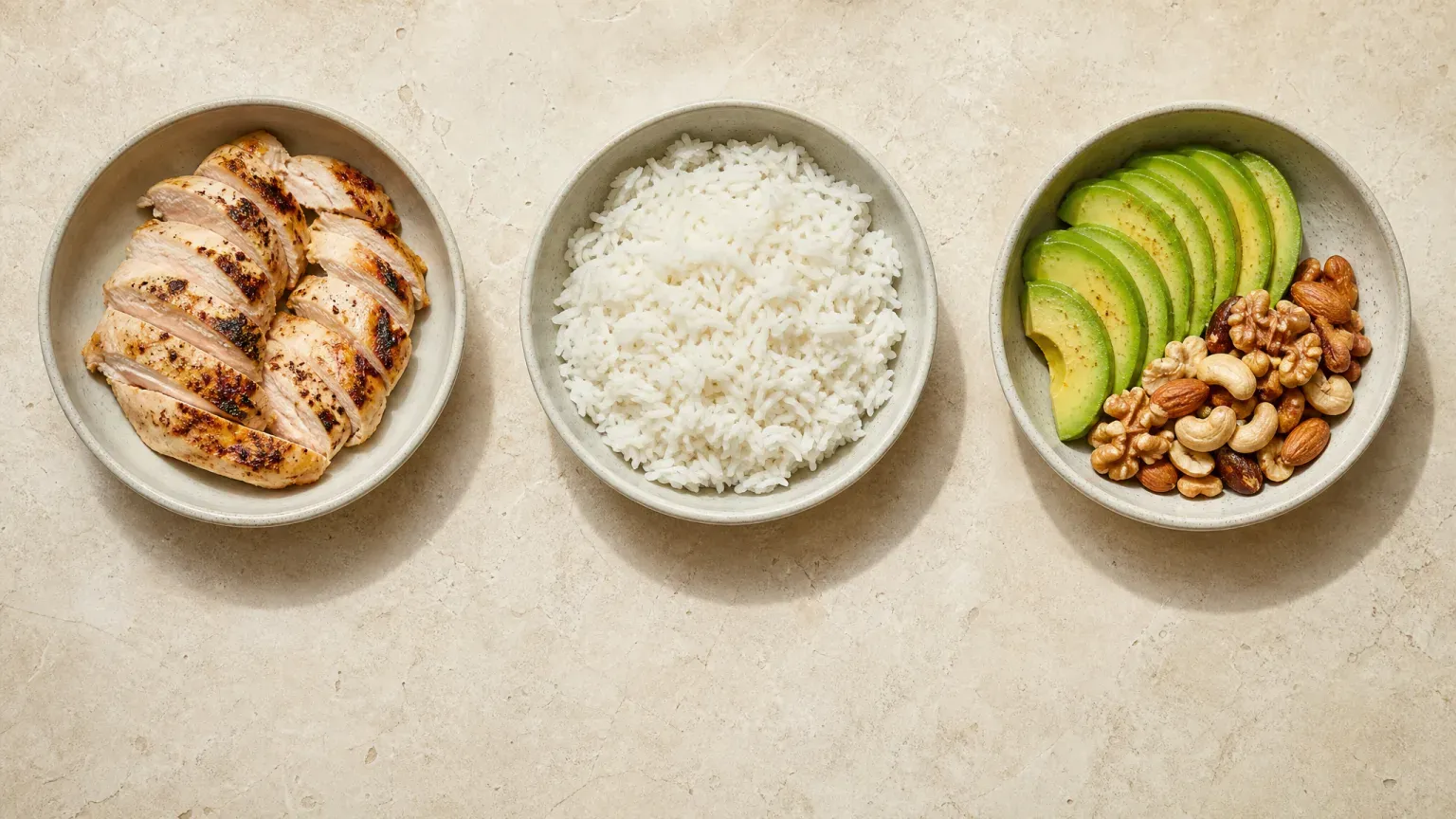
Set the calorie target first, because that is what determines whether you lose weight. Then set protein, which determines how much of the loss is fat rather than muscle. Whatever calories remain get divided between carbs and fat according to what you enjoy eating. That order matters, and most macro advice gets it backwards by starting with a percentage split.
Step 1: the calorie number comes first
Macros are a way of dividing your calories, so there is nothing to divide until you have a total. Work out maintenance from your body and activity, then subtract enough for a deficit you can hold. A 500 calorie daily deficit produces roughly a pound of loss per week, which is a sustainable rate for most people.
If you have not set that number yet, the daily calorie calculator and the calorie deficit calculator will do the arithmetic. Come back once you have a target.
Step 2: protein, defended
Protein is the macro to set deliberately. During a deficit your body will take some tissue from muscle unless you give it a reason not to, and protein plus resistance training is that reason. It also has the strongest effect on fullness per calorie, which makes the deficit easier to hold.
Aim for 0.7 to 1.0 g per pound of goal body weight, or 1.6 to 2.2 g per kilogram. Use your goal weight rather than your current weight so the number does not inflate.
Someone aiming for 150 lb needs roughly 105 to 150 g per day. At 4 calories per gram that is 420 to 600 calories, which on a 1,800 calorie target is about a quarter to a third of the day.
Step 3: fat has a floor
Fat is not optional. It carries the fat-soluble vitamins A, D, E and K, and it supports hormone production, which is why very low fat diets tend to feel bad after a few weeks.
Keep fat at 20 percent of calories or more. On 1,800 calories that is 40 g at the floor. Most people are comfortable between 25 and 30 percent.
Step 4: carbs get the remainder
Whatever is left goes to carbohydrate. This is the part people agonize over and it deserves the least attention.
The research is consistent: when calories and protein are held equal, moving the remaining calories between carbs and fat produces very similar fat loss. Low-carb diets often show faster early results, but that is glycogen and the water bound to it leaving, not additional fat.
What carbs do affect is training. If you lift or run, carbohydrate is the fuel for it, and cutting it too far makes sessions feel heavy for no fat-loss benefit.
Starting splits that work
Any of these is a reasonable place to begin:
| Split (P / C / F) | Suits |
|---|---|
| 30 / 45 / 25 | The default. Balanced, easy to eat, works for most people. |
| 35 / 35 / 30 | Higher protein, moderate carbs. Good if hunger is the main obstacle. |
| 30 / 25 / 45 | Lower carb. Reasonable if you prefer eating this way, not because it burns more fat. |
| 30 / 50 / 20 | Higher carb. Suits people training hard four or more days a week. |
On 1,800 calories, the first row works out to 135 g protein, 203 g carbs and 50 g fat.
Step 5: track for two weeks, then adjust
A split is a hypothesis. Two weeks of data tells you whether it was right.
Watch three things: whether your weight trend is moving at the rate you planned, whether you are hungry enough to be at risk of quitting, and whether training feels worse than it did. Then adjust one variable at a time.
- Weight not moving after two weeks? Your real intake is above your logged intake. Tighten the logging before you cut calories further.
- Hungry all the time? Move 5 percent from carbs or fat into protein.
- Training feels flat? Move 5 percent from fat into carbs and keep protein where it is.
Reassess every two to four weeks rather than daily. Body weight moves several pounds on water alone, and reacting to single readings produces changes that undo each other.
Making the numbers visible
Hitting three targets is harder than hitting one, because you only find out you have missed at the end of the day when there is nothing to be done about it.
That is an argument for logging as you eat rather than at bedtime. Caloryx breaks every logged meal into protein, carbs and fat against the targets you set, so at 2pm you can see that you are 60 g of protein short with two meals left, which is still a solvable problem. You set the split during onboarding, in percentages or grams, and adjust it whenever the two-week review says to.
The part that matters
Protein set correctly and calories set correctly do nearly all the work. The carb-to-fat ratio is a preference dial, and its main effect on your results runs through whether it makes the diet something you can keep doing. Pick the row of the table that sounds like food you would eat on a normal Wednesday, run it for two weeks, and let the trend tell you what to change.
